




Crypto traders are already assigning Elon Musk’s SpaceX stock a public-market valuation before the rocket and satellite company has filed for an IPO.
On May 17, Hyperliquid-powered Trade.xyz launched a SpaceX pre-IPO perpetual futures contract, creating a live, cash-settled market for traders to bet on where the private company could trade when it eventually lists.
According to the firm, the contract will trade under the ticker SPCX-USDC, opened with a $150 reference price based on SpaceX’s reported 11.87 billion fully diluted shares.
That starting point implied a SpaceX valuation of about $1.78 trillion, placing the contract inside the $1.75 trillion to $2 trillion range that SpaceX has reportedly targeted for a public offering.

However, SPCX’s trading quickly moved above that level as its value rose to as high as $216, pushing the implied valuation beyond $2.5 trillion before settling near $203.
At the same time, the first 12 hours of trading generated more than $40 million in volume, showing how quickly crypto-native traders moved into a market that has no equivalent on traditional public exchanges.
The early move gives SpaceX a shadow market before Wall Street has an official listing price, underwriting range, or public filing to analyze.
It also extends one of crypto’s fastest-growing market-structure experiments into the private-company arena, where access has historically been limited to venture funds, employees, secondary-market investors, and large institutions.

SPCX gives traders a market before SpaceX IPO
The SpaceX contract is the second pre-IPO perpetual market launched by Trade.xyz after Cerebras Systems, which began trading on May 1 under the CBRS ticker.
The Cerebras product gave traders an early test case for synthetic price discovery around private companies. Market observers noted that its trading price closely tracked the eventual listing price, offering Trade.xyz an early validation point as it expands into larger, more closely watched companies.
SpaceX gives that model a much bigger stage. The company sits at the center of several public-market themes, including reusable rockets, satellite internet, defense contracts, private space infrastructure, and Elon Musk’s broader corporate network.
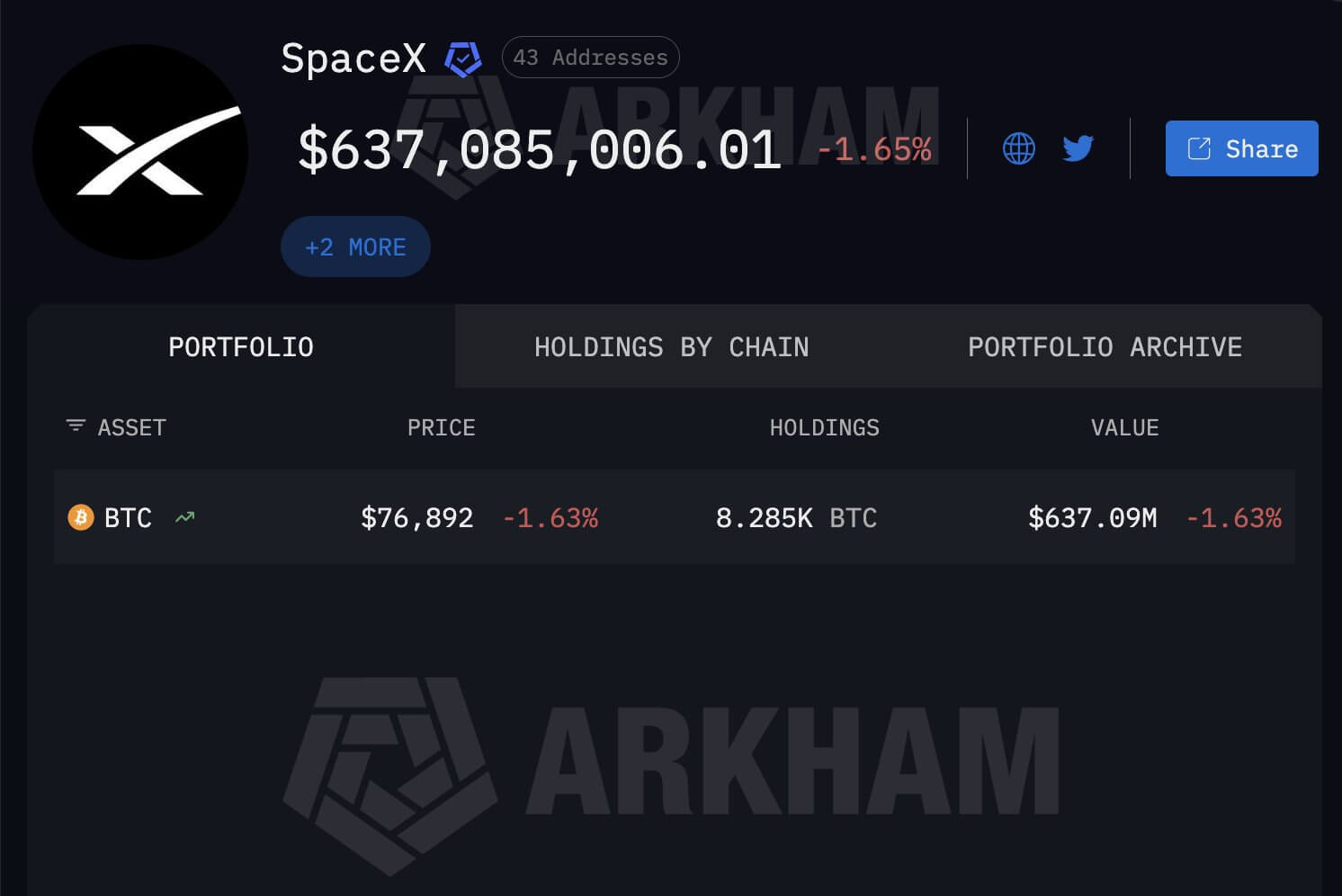
Data from Arkham Intelligence shows that the firm is also holding about 8,285 Bitcoin in Coinbase Prime custody, valued at about $637 million.
For these reasons, its potential listing has long been viewed as one of the most consequential IPO candidates in the world, even though the company has yet to file an S-1 registration statement.
SPCX effectively creates a market-implied view of that future valuation. Traders can go long or short the contract using USDC as the quoted asset, with the price reflecting positioning, funding dynamics, and the market’s expectation of how SpaceX could be valued in a public-market debut.
The structure also gives crypto traders exposure to a company that has remained unavailable through normal public-market channels.
SpaceX shares trade through private secondary markets and tender offers, but those venues are fragmented, restricted, and often inaccessible to retail investors. A Hyperliquid-listed perp changes the access point, even though it gives no ownership claim on the underlying company.
SPCX presents opportunities and risks to the market
While early trading in SPCX shows clear demand for SpaceX exposure, the contract’s credibility will depend on whether its price series remains coherent as liquidity builds and the company moves closer to a public listing.
Alvin Kan, COO of Bitget Wallet, told CryptoSlate that Hyperliquid’s launch of pre-IPO perpetuals tied to companies such as SpaceX opens private-company narratives to a broader trading audience through liquid, always-on crypto markets.
Kan said the appeal is straightforward because users can gain synthetic exposure to high-profile companies that have historically been difficult to access.
However, he warned that these products differ sharply from traditional pre-IPO investing or tokenized equities because traders are speculating on valuation and market sentiment rather than acquiring ownership, shareholder rights, or claims on underlying shares.
According to him:
“The opportunity is that crypto infrastructure can dramatically expand access and price discovery around private-market demand… The challenge is that pricing these assets is inherently difficult because there is no continuous public-market benchmark behind them.”
He also added that early liquidity could be driven more by short-term speculation than deep institutional participation, making oracle design and reference pricing critical.
Kan said the closer these products appear to equity exposure in practice, the more important transparency becomes around what users are actually buying, particularly from a regulatory and investor-protection standpoint.
Nicolai Sondergaard, a research analyst at Nansen, also told CryptoSlate that SPCX is structurally significant because it extends crypto-native liquidity into late-stage private-company exposure, an asset class historically limited to venture investors, employee tender markets, and secondary-share buyers.
At the same time, Sondergaard said the launch will test whether perpetual futures can serve as a credible price-discovery venue for a company with no public float and limited financial disclosure.
According to him:
“[SPCX] tests whether onchain perp mechanics, continuous funding rates, permissionless access, 24/7 trading, and synthetic settlement can function as a credible price-discovery venue for a company with no public float and limited public financial disclosure.”
That test, Sondergaard explained, carries obvious risks because a perpetual contract without a liquid underlying spot market can end up pricing a narrative as much as an asset.
Its funding rates may reflect positioning and sentiment, while the lack of delivery or redemption mechanisms means the contract can drift away from any reasonable estimate of intrinsic value.
That risk is especially relevant for SpaceX. The company’s cap table is complex, secondary-market data is limited, and Starlink’s financial profile remains difficult to assess from the outside.
Those gaps leave traders relying on reported tender valuations, investor expectations and market appetite for Musk-linked assets.
Still, SPCX could become a useful signal if liquidity deepens and the contract maintains a stable relationship with known private-market pricing.
It could also become a speculative venue where sentiment around SpaceX, Starlink, Musk, and broader risk appetite moves faster than fundamentals.

Hyperliquid’s expansion brings Washington into the frame
Meanwhile, the new SpaceX contract also lands at a sensitive moment for Hyperliquid, the leading decentralized exchange.
Over the past months, the decentralized derivatives platform has grown into one of the most active crypto trading venues, helped by demand for around-the-clock markets tied to crypto assets, commodities, equities, and other synthetic instruments.
This has become particularly evident during the ongoing US-Israel-Iran war, where traders used Hyperliquid to hedge exposure to oil, gold, silver, and US equities while traditional markets were closed.
That growth has brought more attention from policymakers and traditional market operators like CME Group and ICE’s New York Stock Exchange.
Their concerns center on market surveillance, jurisdiction, manipulation risk, sanctions compliance, and whether public-blockchain derivatives should operate under a regulatory framework designed for centralized exchanges.
In response to this scrutiny, Hyperliquid has increased its policy presence in Washington.
Last week, the platform’s founder, Jeff Yan, said that he met with US lawmakers to discuss on-chain derivatives and a regulatory path for bringing blockchain-based trading markets into the US.
Yan said some conversations were technical, while others focused on decentralized finance and the demand for onchain markets. He added that he saw bipartisan interest in crypto regulation and expected the discussions to continue.
The Hyperliquid Policy Center has also pushed back against criticism from incumbent exchanges, arguing that the platform’s public ledger creates a full real-time record of transactions. The group has said that transparency can help surveillance, detection, and investigation by regulators and law enforcement.
That argument is now being tested against more complex products, like a SpaceX pre-IPO perp, which raises different questions than a Bitcoin or Ethereum contract.



Be the first to comment